NEET 2026 Result Is Out — Here's Who Actually Profits From It
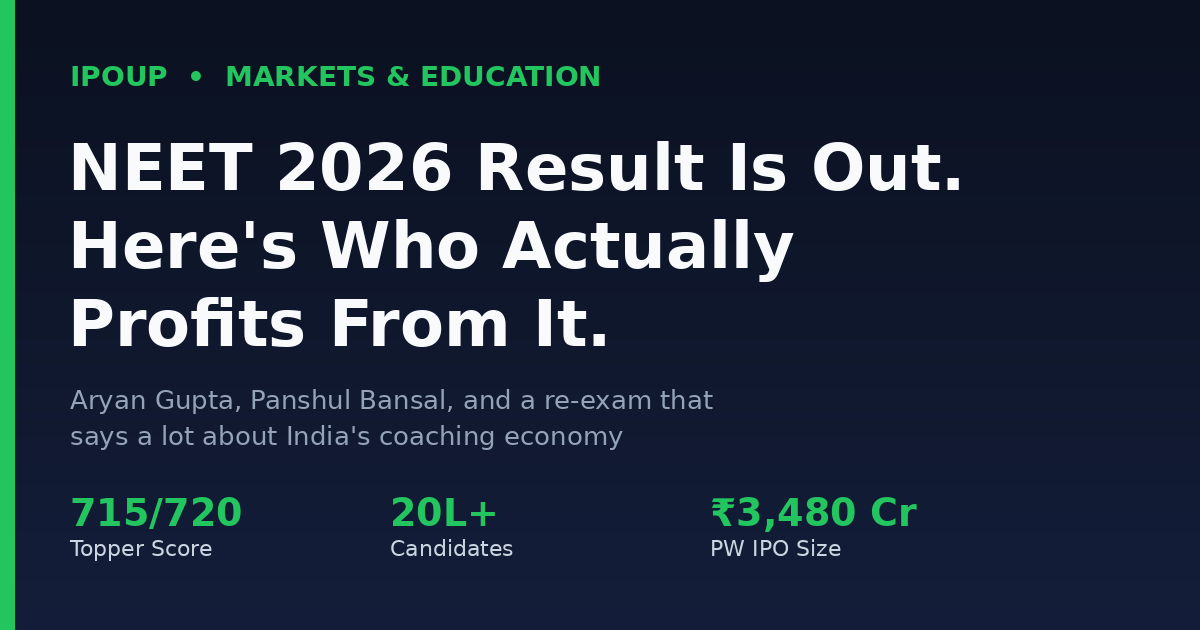
NEET UG 2026 results are out, with Aryan Gupta and Panshul Bansal topping at 715/720. Here's how this year's paper-leak re-exam, Sonam Wangchuk's reform push, and India's listed edtech players like PhysicsWallah connect to the real money in the coaching industry.
The NEET UG 2026 result is finally out, and if you've been anywhere near a WhatsApp family group this week, you already know: Aryan Gupta from Punjab and Panshul Bansal from Haryana have jointly topped the exam with 715 out of 720 marks. The National Testing Agency released the result on July 16, along with the merit list, category-wise cutoffs, and scorecards for the roughly 20 lakh students who sat for the exam.
Normally that would be the whole story: a topper, a cutoff, a few lakh relieved or heartbroken families. But NEET 2026 has not been a normal year, and once you follow the money, it stops being just an education headline and turns into a genuine finance story.
Why this year's result even needed a "re" in front of it
Search "re neet result 2026" enough times and you'll notice the exam most people took wasn't the first attempt. NEET UG 2026 was originally held on May 3 for over 2.27 million candidates. Nine days later, the NTA cancelled the entire exam after investigators found a leaked "guess paper" in Rajasthan with roughly 140 questions matching the actual paper. The CBI got involved, arrests followed, and the agency ordered a fresh nationwide re-exam on June 21 rather than try to isolate which candidates had cheated.
That's an unusual, expensive decision. Re-conducting an exam of this scale means new admit cards, new logistics across 5,440 centres in 551-plus cities, refunded fees, and a compressed counselling calendar for MBBS, BDS, AYUSH, and nursing seats. It also meant the government briefly restricted Telegram access in the days before the retest, worried that fake leak rumours would spook students all over again.
Where Sonam Wangchuk fits in
This is the part that doesn't usually make it into NEET result roundups. In June 2026, Ladakh-based education reformer Sonam Wangchuk travelled to Delhi to join student demonstrations at Jantar Mantar demanding reform of the exam system, directly in response to the NEET leak episode. Wangchuk has spent close to four decades arguing that India's education model, built around SECMOL in Ladakh, rewards memorising a textbook over actually understanding anything, and that a single high-stakes exam controlled by one central agency is a fragile way to decide a teenager's entire future.
He has a point that's worth sitting with even if you don't agree with all of it: a leak at the paper-printing stage was enough to derail the year for 2.27 million students. Systems that concentrated shouldn't fail that easily. Whether you find that argument persuasive or think it understates how hard it is to run a fair exam for millions of people at once, it's the honest context behind why this year's "re-exam" language exists at all.
Now, the finance angle, and it's a real one
Here's where NEET stops being just a school story. Every May and July, when results and cutoffs land, India's coaching and edtech sector gets a demand shock, and some of that sector is now sitting on public markets.
The clearest example is PhysicsWallah. It listed on the BSE and NSE in November 2025 after a ₹3,480 crore IPO, a fresh issue of about ₹3,100 crore plus an offer for sale by founders Alakh Pandey and Prateek Maheshwari. The listing wasn't a blowout; institutional demand carried it after a fairly muted retail response. But the business underneath has held up: PhysicsWallah posted a profitable Q3 FY26, with revenue up sharply year-on-year and positive operating cash flow, largely on the back of test-prep verticals that include NEET and JEE coaching. A results season like this one, a delayed exam, a re-test, anxious parents, fresh admissions counselling, is exactly the kind of event that drives enrolment and ad spend toward players like this.
PhysicsWallah isn't alone in that space, just the one you can actually buy shares in right now. Aakash Institute (under Byju's parent group) and Allen Career Institute (backed by Bodhi Tree and other private investors) are the two other giants in NEET coaching, and both have been the subject of IPO speculation for years without pulling the trigger yet. A chaotic, headline-heavy NEET cycle like 2026, with a leak, a cancellation, a re-exam, and heavy cutoff scrutiny, tends to push anxious parents toward the "bigger, safer" coaching brands rather than local tutors, which is precisely the kind of tailwind that makes a coaching major look more IPO-ready to its investors.
One clarification worth making bluntly: the NTA itself doesn't profit from any of this. It's a government-run testing body, not a company, and it doesn't have shareholders. The commercial upside from a NEET cycle flows to the ed-tech and coaching businesses built around the exam, not the agency that conducts it. For a deeper look at which of those businesses are actually profitable versus which are barely surviving, we broke it down in our follow-up on India's edtech finances.
What this means if you're tracking the IPO market
If you're watching the listed edtech space, results season is a genuine catalyst worth tracking, not just a school-news distraction. Watch enrolment numbers and quarterly guidance from PhysicsWallah around each results cycle, and keep an eye on whether Aakash or Allen finally file draft papers. A controversy-heavy year like this one, ironically, tends to make the case for going public look stronger, since it shows demand for structured coaching holds up even when the exam itself has a terrible year.
And if you're one of the 11.2 lakh students who qualified this year: congratulations, the counselling process through MCC and state boards starts now. If you didn't make the cutoff, you're in the same room as several hundred thousand other people re-planning their year. Not a fun place to be, but not a rare one either.
Comments
No comments yet
Be the first to share your thoughts!