Byju's, Unacademy, PhysicsWallah: Who's Actually Making Money in EdTech
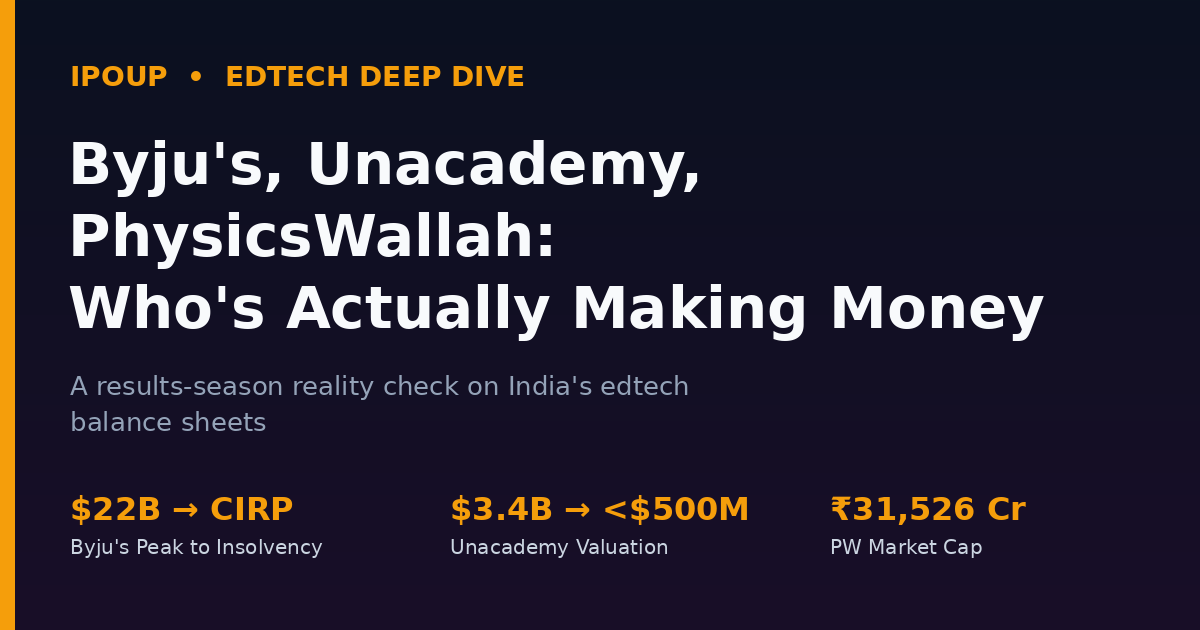
Byju's is in insolvency proceedings. Unacademy's valuation has fallen more than 90 percent. PhysicsWallah is profitable and listed on the NSE. A finance-first look at what India's biggest edtech names actually stand for behind the marketing.
Every NEET and JEE results season, the same five or six edtech names show up in every ad break and every sponsored Instagram reel: Byju's, Unacademy, Vedantu, Aakash, Allen, PhysicsWallah. We wrote about how this year's NEET 2026 result cycle feeds that industry, but that piece left one honest question unanswered: which of these companies is actually solvent? Because the gap between "raised a lot of funding" and "runs a real business" has never been wider in Indian edtech than it is right now.
Byju's: from $22 billion to a bankruptcy tribunal
Start with the one everybody knows. Byju's was valued at $22 billion at its 2022 peak, backed by names like Peak XV Partners, General Atlantic, and the Chan Zuckerberg Initiative, and it spent that money the way you'd expect: a $1 billion acquisition of Aakash Educational Services, a jersey sponsorship for the Indian cricket team, Lionel Messi and Shah Rukh Khan endorsements. None of that fixed the core problem, which was that the tutoring business under the marketing was losing money at a pace the funding rounds could no longer cover.
The unwind has been messy and slow. Think and Learn Private Limited, Byju's parent, was pushed into insolvency proceedings in July 2024 after a claim from the BCCI over unpaid sponsorship dues. Since then it has been stuck in a loop of tribunal orders: creditors added and removed from the committee of creditors, resolution professionals challenged, a proposed BCCI settlement struck down by the Supreme Court, and the matter still working its way through the NCLT and NCLAT as of this year. Along the way, Byju's lost control of Aakash entirely after failing to meet the terms of that original acquisition, and had to write off the full billion-dollar investment. That's the part worth sitting with: the company that once looked like it would define Indian edtech doesn't own the one asset (Aakash) that was actually built for the exam-coaching business its rivals are now profiting from.
Unacademy: the valuation cut that tells the real story
Unacademy peaked at a $3.4 billion valuation in 2021, on the back of a pandemic bet that online learning demand was permanent. It hired around 6,000 people, acquired more than ten companies including PrepLadder, and spent aggressively on educator contracts and marketing. When students went back to physical classrooms and offline coaching, the demand didn't hold, but the cost base did. The company posted a loss of roughly ₹2,848 crore in FY22 on revenue of about ₹1,300 crore, one of the worst loss-to-revenue ratios in Indian startup history outside Byju's itself.
The correction since then has been brutal and public. Layoffs, salary cuts for the "star" educators who were once paid crore-scale contracts, a pivot toward offline centres to cut cash burn, and a founder-confirmed valuation of under $500 million by the end of 2025, a fall of more than 90 percent from the peak. Talks to sell the company to Allen Career Institute for around $800 million reportedly fell apart over price. Unacademy is still operating, but it's operating as a company trying to survive its own growth phase, not one positioned for an IPO any time soon.
Vedantu: the quiet, smaller cousin
Vedantu never chased the scale that Byju's and Unacademy did, and it shows in both directions. Revenue has stayed roughly flat rather than collapsing, and the company has pivoted toward a hybrid model with physical learning centres alongside its online classes, prioritising a sustainable cost base over aggressive growth. It still posted a loss of around ₹157 crore in FY24. Not a crisis on the scale of its bigger rivals, but not a business with a clear profitability story either.
PhysicsWallah: the one that actually turned a profit
Then there's PhysicsWallah, and the contrast with the names above is stark. It was bootstrapped in its early years, built around founder Alakh Pandey's YouTube physics lectures before turning into a full test-prep and upskilling platform. It reported around ₹2,887 crore in FY25 revenue, roughly three and a half times Unacademy's, and unlike Unacademy or Byju's, it did that while staying profitable. Its November 2025 IPO raised ₹3,480 crore, valued the company at around ₹31,526 crore, and delivered a listing-day gain of just over 31 percent even though the subscription numbers going in were fairly muted.
The business underneath the listing has kept performing. Nine months into FY26, revenue had already crossed the full-year FY25 number, and the company posted a positive PAT and healthy operating cash flow in its most recent quarter, largely carried by test-prep verticals that include NEET and JEE coaching alongside newer upskilling courses in data science and finance. It's a genuinely unusual position for an Indian edtech company to be in: profitable, listed, and growing off the same exam-season demand that's currently bankrupting one competitor and eating into another's valuation.
What Aakash and Allen actually are right now
Aakash and Allen sit outside this public-market picture entirely, which is itself informative. Aakash, now controlled by its lenders and investors rather than Byju's after the failed acquisition, remains one of the two dominant NEET coaching brands by sheer scale of physical centres. Allen, backed by Bodhi Tree and other private investors, is the other. Both have been the subject of IPO speculation for years without either actually filing paperwork, which suggests their owners either don't need the capital yet or aren't confident the public markets will value a coaching-heavy, lower-margin business the way they'd like.
If you want the exam-season context behind why these NEET-linked names matter so much right now, we cover it in our piece on the NEET 2026 result and its effect on the IPO market.
The pattern underneath all of this
Line these five up and a clear divide shows up. Byju's and Unacademy raised money on the assumption that pandemic-level online demand was the new normal, built cost structures for that world, and got punished hard when it didn't hold. Vedantu scaled down early enough to avoid the worst of it, but never built a profitable core. PhysicsWallah is the one company here that grew inside the actual exam-coaching demand cycle, NEET and JEE season after season, without assuming that demand would ever be anything more than seasonal and recurring. That's the difference between a story and a balance sheet, and it's why one of these names is on the NSE and the rest are either in a tribunal or in a holding pattern.
Comments
No comments yet
Be the first to share your thoughts!