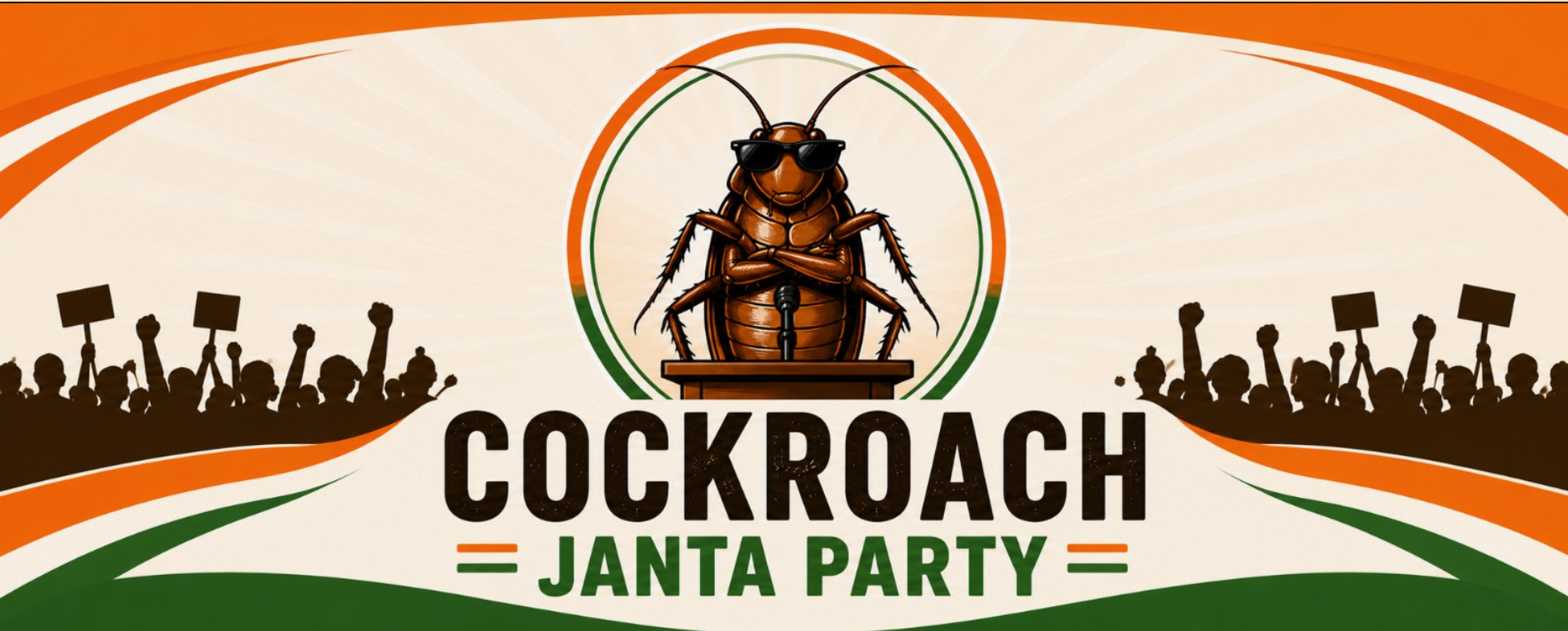
Cockroach Janta Party: What the Viral Movement Means for India's Markets
Cockroach Janta Party: The Viral Political Trend Every Market Watcher Should Be Tracking
Published on ipoup.in — Markets, IPOs and Capital Sentiment

When a new political outfit calling itself the Cockroach Janta Party (CJP) crossed 40,000 members in under 48 hours, broke into national news cycles, and pulled two sitting Lok Sabha MPs into its membership column, it stopped being just a meme. For investors, IPO watchers and corporate-governance trackers, sudden bursts of political virality are not background noise — they are leading indicators of policy mood, regulatory risk and the kind of brand-equity shocks that move listed companies.
At ipoup.in, we usually decode IPOs, listing-day movement and primary-market sentiment. But the CJP story is a case study in how political virality intersects with capital markets — from media-house valuations to corporate disclosure norms to election-cycle policy risk. Here is a measured, analytical breakdown of what the Cockroach Janta Party is, who is behind it, and why it deserves a slot on your market-watch dashboard.
The official party site, for readers who want to read the manifesto in full, is available at cockroachjantaparty.org.
What Exactly Is the Cockroach Janta Party?
The Cockroach Janta Party describes itself with the motto "Secular, Socialist, Democratic, Lazy" and positions itself as a political front "of the youth, by the youth, for the youth." Less than a week old, the CJP is still unregistered with the Election Commission but has already produced a website, a five-point manifesto, an AI-generated anthem and a poll symbol — the mobile phone.
The trigger for the launch was a controversial remark in court by Chief Justice of India Surya Kant, who reportedly compared certain unemployed youth entering professions like journalism, law and RTI activism to "cockroaches" and "parasites" attacking the system. The CJI later clarified he had been misquoted and was referring only to those using bogus degrees. By then, the term had already gone viral, and a Pune-based political commentator named Abhijeet Dipke had built a satirical political brand around it.
Within two days, the party claimed to have admitted Trinamool Congress MPs Mahua Moitra (Krishnanagar) and Kirti Azad (Bardhaman–Durgapur), both of whom publicly engaged with the CJP's social handles. Social activist Anjali Bhardwaj and former civil servant Ashish Joshi also joined the conversation.
Who Is Abhijeet Dipke?
CJP's founder is not a first-time entrant into Indian political messaging. Reports from the 2020 Delhi Assembly election cycle, including coverage in The Indian Express and Hindustan Times, identified Dipke as a 23-year-old from Pune who handled meme campaigns and social-media strategy for the Aam Aadmi Party (AAP), reporting to then–IT media head Ankit Lal. He was credited with steering AAP's meme-driven outreach to millennials and first-time voters, and with running parts of the party's election war room and WhatsApp/Facebook coordination cells.
Whether the CJP is a clean break from that lineage or an extension of the same playbook is debated. Outlets like OpIndia have framed it as a continuation of AAP-adjacent political messaging, while The Federal's Capital Beat featured Dipke explaining it as an "impulsive" social experiment. For market readers, what matters is less the politics and more the fact that an experienced political-digital operator is now able to mobilise 40,000+ members and trend nationally within 48 hours — a speed of mobilisation that has implications for how quickly public sentiment can move against a sector or a stock.
The Manifesto: Why Markets Should Pay Attention
CJP's five-point manifesto sits squarely at the intersection of satire and serious policy demands. Four of the five points carry direct read-throughs for listed companies and the regulatory environment:
1. No post-retirement Rajya Sabha seats for Chief Justices. A signal that judicial-appointment reform is climbing back up the public agenda — relevant for sectors where regulatory and judicial interventions drive valuation, such as telecom, mining and pharma.
2. UAPA arrest of the Chief Election Commissioner if any "legit vote" is deleted. Hyperbolic in framing, but it taps into the broader Special Intensive Revision (SIR) debate and electoral-roll integrity narrative. Markets typically price in election uncertainty in the six months before a national vote.
3. 50% reservation for women in Parliament and Cabinet without expanding the House. A direct comment on the delimitation exercise, which will reshape parliamentary representation and, by extension, state-level policy priorities that affect everything from MSP regimes to industrial subsidies.
4. Cancellation of media licences for houses linked to Ambani and Adani, with investigations into "Godi media" anchors' bank accounts. This is the one that should land on every equity desk's radar. Reliance Industries (via Network18) and the Adani Group (via NDTV) have meaningful media-sector exposure. Calls — even satirical ones — for licence cancellation feed into the broader narrative risk these stocks already carry on ESG and governance screens.
5. 20-year ban on MLAs/MPs who defect. A demand that, if it ever translated into actual anti-defection reform, would compress the political-uncertainty premium that markets sometimes price into state-level policy.
Social activist Anjali Bhardwaj suggested three additions that the CJP "accepted": RTI accountability for the party, no anonymous donations or electoral-bond-style instruments, and no "Cockroach CARES Fund." These are, in effect, transparency demands that mirror live debates around political-funding disclosure.
The Market & Brand-Virality Angle
For ipoup.in readers, the deeper story is not the party — it is the speed and shape of the virality. Three takeaways are worth filing away for the next time you screen a listing or a sentiment-driven stock:
Sentiment can outrun fundamentals. A satirical entity with no registration, no candidates and no real organisational structure pulled in 40,000 self-declared members faster than most newly-listed SMEs build their first 40,000 retail shareholders. Whatever you think of the politics, the user-acquisition curve is a benchmark for what's possible in a high-trust, high-meme cohort.
Narrative risk for listed conglomerates is non-linear. Once a single phrase ("Godi media", "cockroach", "vote deletion") gets memed into mainstream conversation, the discount applied to stocks named in that narrative widens. Investors holding media-exposed names within Reliance and Adani should track how often these narratives surface — not because the demands will pass, but because they shape ESG scores and FII positioning.
Election-cycle volatility is starting earlier. Movements like CJP, whether organic or engineered, lengthen the window in which markets must price political-narrative risk. Defensive sectors (consumer staples, IT) historically outperform during these windows; cyclicals and PSU plays tend to see wider spreads.
Will the CJP Last?
That remains an open question. The party has announced a virtual Gen-Z convention, opened nationwide feedback channels, and pegged its eligibility criteria as "unemployed, lazy, chronically online, with the ability to rant professionally." Whether it formally registers with the ECI, fields candidates or quietly fades into the next news cycle will determine whether it becomes a footnote or a genuine new node in India's opposition ecosystem.
For now, the CJP is a useful reminder that in 2026, political brands can be spun up in 48 hours, draw sitting MPs into their orbit, and start shaping the policy conversation around media, judiciary and electoral integrity — all before they've even filed a registration form. For anyone tracking IPOs, regulatory cycles or the listed-equity exposure of India's largest conglomerates, that is a market-relevant signal, not a meme.
Readers who want to follow the party's own statements and manifesto can do so on the official site at cockroachjantaparty.org.
ipoup.in tracks IPOs, primary-market sentiment and the policy-and-narrative shifts that move listed equity in India. This piece is an analytical explainer and is not investment advice.
Sources: India Today, OpIndia, The Federal — Capital Beat, Reddit r/AskIndia, cockroachjantaparty.org.
Comments
No comments yet
Be the first to share your thoughts!